Pennsylvania
News from the road and life

And now day breaks
over ridge and valley.
day breaks
and if you find yourself right here
go on, let the landscape tell you a story.
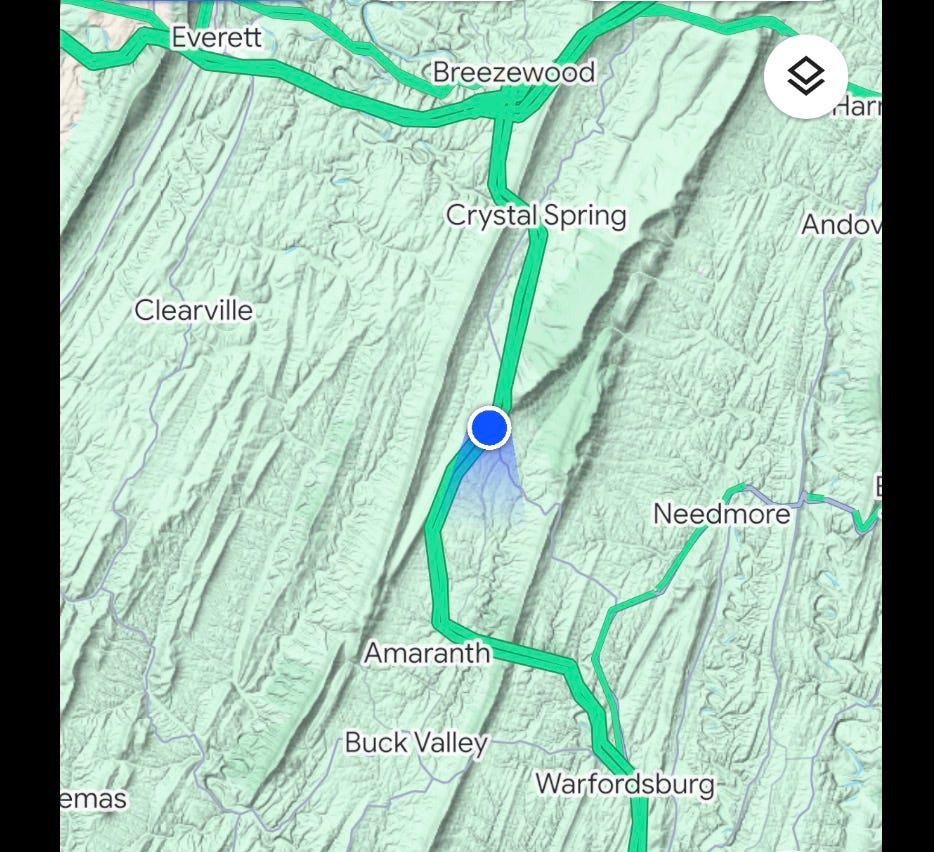
My truck moves
at the speed of whale
crossing deep
Cumberland.
how easy to be swept up
in these folds.
Each one a world unto itself.

On a ridge top
The king of pennsyl-tucky
has his court
proffers pastries
but demands a toll
be placed in his boot
I’m too awlde
He says
to use a QR cowde
the drawl in my mouth is
a beautiful 12 string
I can’t play well.
Wild notes:
Take the pike
if you can
draw a line to
Mary-land
valley black
ridgetop blue
tear thru timber
put corn in too.
down the national
labyrinth
there is something ugly
and the path is lined with
jewels
go on, let it tell you a story.
—
The man who was the closest this country ever got to a king invaded this region in 1794, when the farmers here rebelled against a special tax on their whiskey. With his treasury secretary, Alexander Hamilton, Washington viewed the tax as a way to bring a semblance of economic normality to the region. The land surveyor and owner in him saw these valleys and uplands as unduly cumbered by independent homesteads and strange networks of exchange, unusual currencies, and so on. Families of squatters had settled here and there on vast tracts of land he himself owned, or claimed to, and paid his property titles no mind when they were brought forth. The source of region’s brazen independent streak was unknown. But its self-sufficiency lay in value-added farm products like spirits. And so, a tax. It was the federal government’s very first, meant to put the region on the road to productivity and citizenship. But the local farmers and distillers wished to keep what they had. They lit fire to the tax warrants, and organized floating bands of militiamen to descend on the collectors. When the national guard was called up, they were defeated. They preserved what remained of the old system underground, or up in the hills, where they took to making their spirits by the light of the moon. By 1796, land values in western Pennsylvania had plummeted, and George Washington himself, having evicted the squatters on his own land some years prior, was forced to sell.